
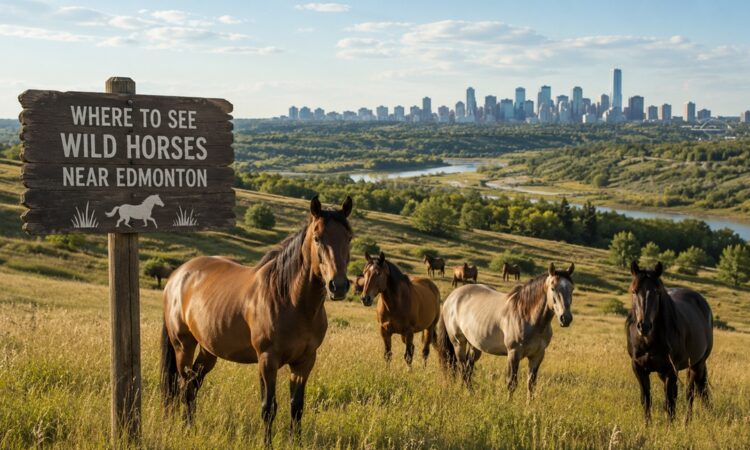
Most people know Alberta for the Rockies, the prairies, and the oil sands. Very few people outside the province know that genuine wild horse herds roam its foothills — horses that descended from domesticated animals released or escaped over a century ago and have been fending for themselves ever since.
If you want to see wild horses near Edmonton, the most reliable location is the Ghost River Wilderness Area and the Sundre area of west-central Alberta, roughly 3–3.5 hours southwest of Edmonton. This is where Alberta’s most photographed wild horse herds spend much of the year.
Are There Really Wild Horses Near Edmonton?
History of Alberta’s Wild Horse Herds
Alberta’s wild horses — sometimes called feral horses or wild mustangs, though they’re distinct from North American mustangs — are descendants of horses brought to the province during the ranching and farming era. Horses that escaped, were released, or were abandoned over generations gradually formed self-sustaining herds in the foothills west of Calgary and Edmonton.
The Ghost-Sundre herd is the largest and most visible population, estimated at several hundred animals. They’re not domesticated, they’re not managed in the same way as livestock, and they’re genuinely wild in behaviour — though they tolerate human observation from a respectful distance.
Where They Roam Today
The primary territory spans public land west of Sundre, into the Ghost River Wilderness Area and adjacent Bighorn backcountry. Seasonal movement takes them higher into the foothills in summer and back toward lower elevations in winter.
Best Places to See Wild Horses Near Edmonton
Sundre, Alberta (Ghost River Wilderness Area)
Distance from Edmonton: Approximately 3–3.5 hours (via Highway 2 south to Highway 587 west)
Sundre is the starting point for most wild horse viewing trips. The Ghost River Road west of town passes through public land where the herds are frequently spotted, particularly in the morning and late afternoon.
This isn’t a guided experience or a designated viewing area — you’re driving forestry roads, pulling over when you spot horses, and observing from your vehicle or a safe standing distance. That’s what makes it genuinely wild.
Best season: May through October for road accessibility. Spring and early summer often bring foals, making this the most visually rewarding period.
Nordegg and Bighorn Country
Distance from Edmonton: Approximately 3.5–4 hours (via Highway 16 west, then south)
The Bighorn backcountry north of Highway 11 near Nordegg sees wild horse activity, though sightings are less predictable than in the Sundre area. If you’re already in the Nordegg area for other reasons — the Abraham Lake ice bubbles in winter, Ram Falls in summer — worth keeping your eyes open.
Ya Ha Tinda Ranch
Distance from Edmonton: Approximately 4.5–5 hours
Ya Ha Tinda is a federal government horse ranch on the eastern boundary of Banff National Park that also borders wild horse territory. The road in is long and rough, but the scenery is extraordinary and wild horse sightings in this area are meaningful — you’re seeing them at the edge of the Rockies.
| Location | Distance from Edmonton | Best Season | Difficulty | Tips |
|---|---|---|---|---|
| Ghost River / Sundre | 3–3.5 hours | May–October | Easy (drive) | Morning/evening best |
| Bighorn / Nordegg | 3.5–4 hours | May–September | Moderate | Less predictable |
| Ya Ha Tinda Ranch | 4.5–5 hours | June–September | Challenging (rough road) | 4WD recommended |
When Is the Best Time to See Wild Horses in Alberta?
Spring (May–June) is the most rewarding time. Foals are often present, the herds are moving to lower elevations after winter, and road conditions are manageable. The landscape is also dramatically green, which makes photography easier.
Summer (July–August) offers the most reliable road access but the horses move to higher elevations, making sightings less predictable along the main routes.
Fall (September–October) is excellent — horses return to lower elevations, autumn foliage adds context to photos, and crowds are minimal compared to summer.
Winter makes most access roads impassable or difficult without 4WD and appropriate preparation. Not recommended for first-time visitors.
How to Observe Responsibly Without Disturbing the Herd
Wild horses in Alberta are not tame. They’ve learned to tolerate vehicle presence at reasonable distances but will flee if approached too closely on foot.
Distance guidelines:
- Stay at least 30 metres from any horse
- Do not attempt to feed them — it habituates them to human contact in harmful ways
- Do not position yourself between a mare and foal
- If horses begin moving away from your position, back off further
The Wild Horses of Alberta Society (WHOAS) has published specific responsible viewing guidelines. Worth reading before your first visit.
Pro Tips for Photographing Wild Horses in Alberta
- A long telephoto lens (300mm+) lets you capture meaningful shots without close approach. This is how the best wild horse photos from Alberta are taken — the horse looks like it’s close; the photographer is actually far away.
- Low light is magic. Dawn and dusk shots in the foothills produce dramatically better images than midday flat light.
- Shoot from your vehicle when possible. Horses are less alarmed by vehicles than by a standing human figure. A car makes an excellent telephoto hide.
- Patience over pursuit. Find a herd, find a position that doesn’t disturb them, and wait. Attempting to follow or cut off a herd produces nothing good photographically or ethically.
Common Mistakes Visitors Make When Seeking Wild Horses
Going without checking road conditions first. Ghost River Road and backcountry access routes can be muddy or washed out after heavy rain. Call the Sundre Forest Area office before making the drive.
Expecting a guaranteed sighting. These are wild animals on public land — not a wildlife sanctuary. Some trips produce incredible encounters; others yield nothing. That’s nature.
Getting out of the vehicle and approaching on foot. This is the most common and most harmful mistake. Stay in or beside your vehicle. Maintain distance.
FAQ
How far is it from Edmonton to see wild horses? The most reliable viewing area near Sundre is approximately 3–3.5 hours southwest of Edmonton. Plan a full day trip, ideally leaving Edmonton early to arrive before noon.
Are Alberta wild horses protected? Wild horses in Alberta exist in a complicated regulatory space. They’re on public land but don’t have the same legislated protection as wildlife species. The Wild Horses of Alberta Society (WHOAS) advocates for their protection and monitors population health.
What time of day are wild horses most active? Early morning and late afternoon — the same pattern as most large ungulates. Midday in summer heat often finds herds resting in shade or moving to water, making them harder to spot.
Alberta’s wild horse herds are one of the most genuinely moving wildlife experiences in western Canada — precisely because they’re not managed, not staged, and not guaranteed. The drive from Edmonton to Sundre through the foothills is beautiful in its own right. If you arrive and spot a band of horses grazing in the morning light below the first ridge of the Rockies, it’s the kind of thing you remember for years. Start planning for May when the foals arrive.